Master of Arts in Communication
Program Overview
The Master of Arts in Communication (MAC) program provides students with a comprehensive understanding of the field of communication through hands-on experiences, small group analysis, and applied coursework. With access to state-of-the-art facilities and a small student-to-faculty ratio, the MAC program prepares students for careers and advancement in the vibrant field of communication.
Bellarmine's MAC program is designed to accommodate working professionals with classes on weeknights. Part-time students may enroll in the spring or fall terms, and will take one or two courses per term until they've completed the 10-course program.
Our courses are taught by full-time faculty members who blend class work and discussion with real-world application and field experiences, to create an optimal learning environment that teaches the future of this dynamic industry. Students will apply communication theory to contemporary organizational and social issues, and they’ll explore ethical and legal issues related to communication across all media.

Designed for Working Professionals
Bellarmine’s M.A. in Communication is built for working professionals, with convenient weeknight classes and flexible enrollment in the fall or spring. While advancing their skills, students also benefit from Bellarmine’s strong connections to Louisville’s business, nonprofit, and media communities. Part-time students typically take one or two courses per term, completing the 10-course program while balancing career and personal commitments.
Hands-On Learning with Full-Time Faculty
Our courses are taught by full-time faculty members who blend class work and discussion with real-world application and field experiences, to create an optimal learning environment that teaches the future of this dynamic industry.
Weeknights
Classes for Working Pros
Small
Student-to-Faculty Ratio
Global
Media, Culture, and Communication Focus
Early Entry Dual Enrollment
This program offers an opportunity for all undergraduate students to complete their undergraduate degree (B.A. or B.S.) along with a Master of Arts in Communication in four-and-a-half to five years. Students who meet admission requirements (grade point average of at least 3.2 and pre-requisite scores of B or higher in PHIL 101 and MATH 200 or 205) may be admitted to the MAC program in the second semester of their junior year and begin taking graduate-level classes at the beginning of their senior year. The MAC courses take the place of up to 12 credits of undergraduate free, unrestricted, elective credits.
Faculty Profiles
Here is a quick snapshot of a few of our faculty members. Read profiles of all of our distinguished faculty.
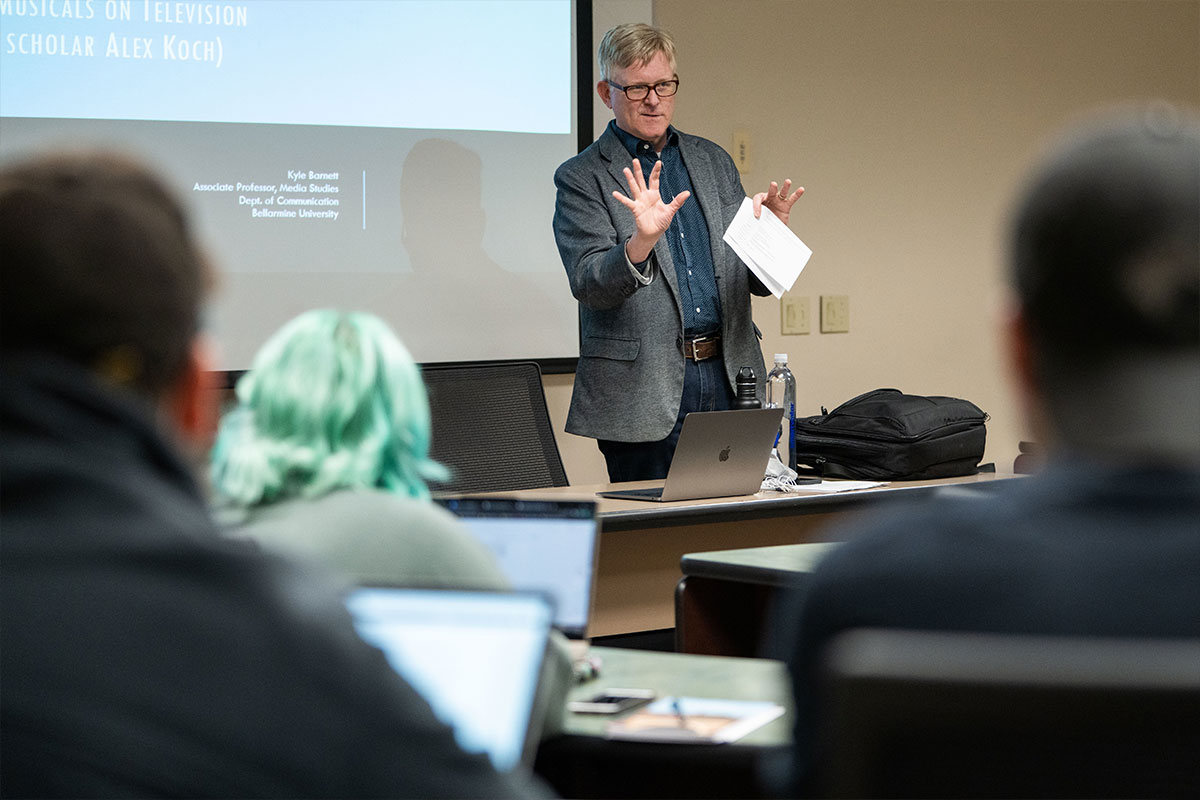
Kyle S. Barnett, Ph.D.

Kyle Barnett’s research focuses on media history, cultural industries, and sound practices across media.
His publications include “Furniture Music: The Phonograph as Furniture,” in the Journal of Popular Music Studies, “The Selznick Studio, ‘Spellbound’ and the Marketing of Film Music,’ in Music, Sound and the Moving Image, and chapters in several book anthologies. Barnett is a former co-editor of the Velvet Light Trap, graduate editor and columnist for Flow, Antenna and In Media Res. Barnett serves as faculty adviser for Bellarmine Radio. He is the author of the book Record Cultures: the Transformation of the U.S. Recording Industry (University of Michigan Press, February 2020).
Barnett’s undergraduate courses include: Media and Society; History of Broadcasting; Film and TV Studies; The Film Musical; Popular Music and the Recording Industry; and Sound Studies. His graduate courses include Introduction to Media Studies and Cultural Industries.
Michael LaRocco, Ph.D.

Dr. LaRocco’s academic research and his creative work as a filmmaker and media artist investigate the evolution of film and video technologies and their application in media practice. His recent publications include articles in Film History and Spectator, and his current book project traces the evolution of digital video camera technology across various communities of practice, from home video to Hollywood.
Prior to his work in academia, he taught media study and production extensively at community-based organizations, art centers, and schools in Chicago, and served for many years on education advisory boards for the Chicago International Film Festival and the City of Chicago Department of Cultural Affairs. He is an active member of the Society for Cinema and Media Studies and recently served on the screening committee for the Peabody Awards.
As a media producer, he trained at esteemed documentary production company Kartemquin Films and has since worked with many clients both behind the camera and in the editing room, including the Lollapalooza Music Festival, filmmaker Ondi Timoner/Interloper Films, Asylum Entertainment, Oxford University, the Chicago Tribune, and the Bebe Miller Dance Company.
Academic areas of interest: Film and television history, theory, and aesthetics; Media technology; Production studies; Practice-based theory; Virtual/augmented reality; Video games; Film and media education; Film, video, and music production; Heavy metal music and culture.
Shawn Apostel, Ph.D.

A graphic designer by trade, Dr. Apostel formerly served as the Communication Coordinator for the Noel Studio for Academic Creativity at Eastern Kentucky University from 2010-2013, and the Information and Graphics Specialist for the City of Toccoa from 2008-2010.
Dr. Apostel's research interests include teaching with technology, applied creativity, digital ethos, e-waste reduction, and visual communication. He is chair of the Visual Rhetoric Panel for the South Atlantic Modern Language Association and serves as a reviewer for various journals and conferences. His work is published by IGI Global, CCDigital Press, Lexington Books, New Forums Press, and Computers and Composition Online. His co-edited book Online Credibility and Digital Ethos: Evaluating Computer-Mediated Communication was published by IGI Global in December, and his co-authored book Teaching Creative Thinking: A New Pedagogy for the 21st Century will be published by New Forums Press this Spring.
Contact
Admissions
Admissions Office
admissions@bellarmine.edu
(502) 272-7100
Take Your Next Step
Start your Bellarmine story. Request information today.
Request InformationCome to campus and see what Bellarmine hospitality is all about.
Schedule Your Visit