DNP, Nurse Anesthesia
Become a Certified Registered Nurse Anesthetist
Program Overview
Named for Dr. Mushtaque Juneja, a Louisville anesthesiologist, entrepreneur and Bellarmine University alumnus, the Bellarmine University Juneja Nurse Anesthesia Program is designed for post-BSN students seeking doctoral preparation for advanced practice as a Nurse Anesthetist. The curriculum provides students with the specialized knowledge and skills necessary to care for diverse patient populations across the lifespan.
Graduates of the program are prepared to assume clinical leadership roles in health-related organizations to improve systems of care, patient outcomes, and quality of care. Upon successful completion of the program, graduates are eligible to sit for the National Certification Exam (NCE) offered by the National Board of Certification and Recertification for Nurse Anesthetists (NBCRNA).
Request Information
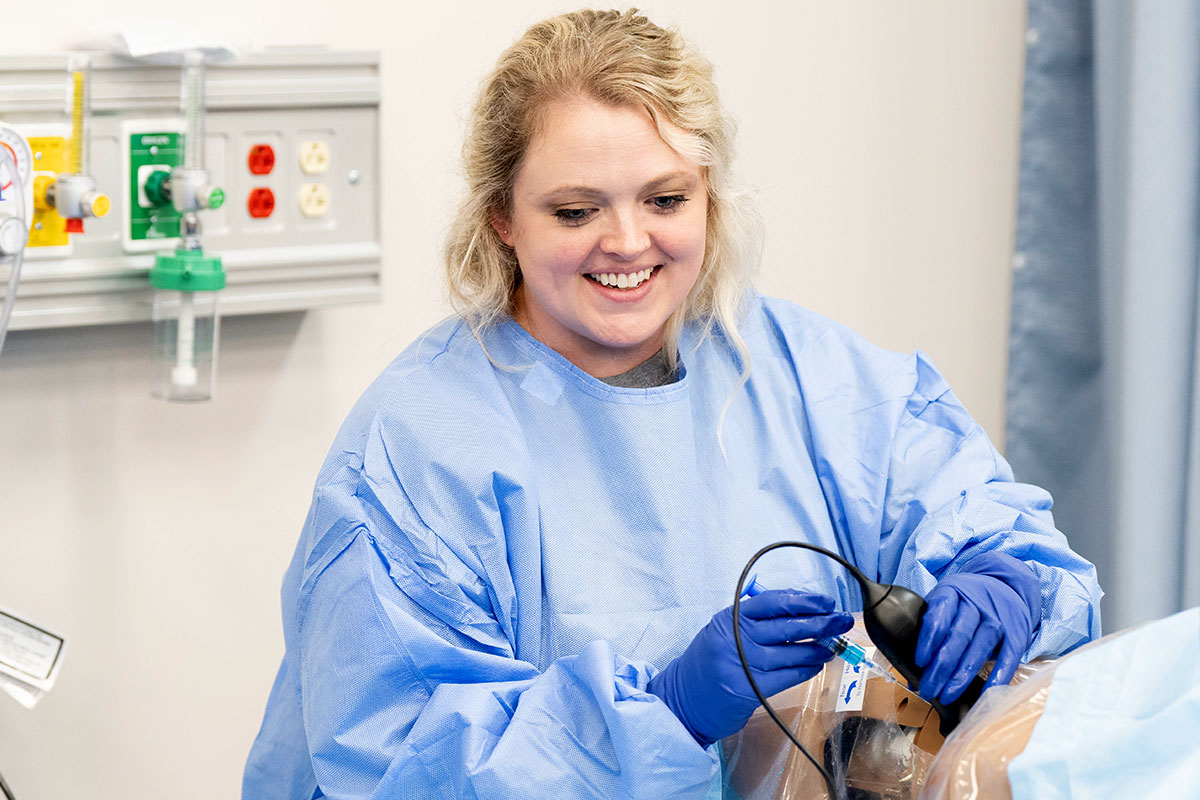
Doctoral Preparation for Advanced Practice
The DNP-NA curriculum prepares post-BSN students for advanced practice as Nurse Anesthetists and for clinical leadership roles that improve systems of care, patient outcomes, and quality of care. Graduates are eligible to sit for the National Certification Exam offered by NBCRNA.
Request Information
Clinical Education Across Leading Regional Sites
The clinical practicum begins in semester four and continues throughout the remainder of the program. Nurse Anesthesia Residents are assigned to anesthetizing locations within leading regional hospitals, including Norton Hospital, Norton Women’s and Children’s Hospital, Norton Audubon Hospital, Norton Brownsboro Hospital, and Norton Children’s Hospital.
Request Information21
Cohort Size
36
Months to complete
5+
Clinical Affiliation Sites
Program Highlights
Certified Registered Nurse Anesthetists (CRNAs) are advanced practice registered nurses who specialize in providing anesthesia care to patients across the lifespan in a wide variety of clinical settings. Bellarmine University’s Juneja Doctor of Nursing Practice–Nurse Anesthesia Program prepares registered nurses for advanced practice as CRNAs through a rigorous curriculum that integrates doctoral education, anesthesia science, simulation, and extensive clinical experiences.
Designed as a 36-month, full-time program, the curriculum is completed over nine consecutive semesters and 100 credit hours. The first two semesters are delivered online, allowing students to begin their foundational doctoral coursework remotely before transitioning to campus for the remaining seven semesters of didactic, simulation, and clinical education.
A new cohort of 21 students begins each August, fostering a close-knit learning environment with individualized faculty support throughout the program.
Application Process
Applications are open each year from August 15 through October 15. All applications submitted by the October 15 deadline must be verified in Nursing CAS by November 1 to be considered. Applicants will be notified via email if selected for an interview with the Nurse Anesthesia Admission Committee in mid-November. Interviews will be held in early December.
Program Outcomes
Upon completion of the DNP-NA program, graduates will demonstrate the ability to:
Patient Safety
- Be vigilant in the delivery of patient care.
- Refrain from engaging in extraneous activities that abandon or minimize vigilance while providing direct patient care (e.g., texting, reading, e-mailing, etc.).
- Conduct a comprehensive equipment check.
- Protect patients from iatrogenic complications.
Perianesthesia
- Provide individualized care throughout the perianesthesia continuum.
- Deliver culturally competent perianesthesia care.
- Provide anesthesia services to all patients across the lifespan.
- Perform a comprehensive history and physical assessment.
- Administer general anesthesia to patients with a variety of physical conditions.
- Administer general anesthesia for a variety of surgical and medically related procedures.
- Administer and manage a variety of regional anesthetics.
- Maintain current certification in ACLS and PALS.
Critical Thinking
- Apply knowledge to practice in decision-making and problem solving.
- Provide nurse anesthesia services based on evidence-based principles.
- Perform a preanesthetic assessment prior to providing anesthesia services.
- Assume responsibility and accountability for diagnosis.
- Formulate an anesthesia plan of care prior to providing anesthesia services.
- Identify and take appropriate action when confronted with anesthetic equipment-related malfunctions.
- Interpret and utilize data obtained from noninvasive and invasive monitoring modalities.
- Calculate, initiate, and manage fluid and blood component therapy.
- Recognize, evaluate, and manage the physiological responses coincident to the provision of anesthesia services.
- Recognize and appropriately manage complications that occur during the provision of anesthesia services.
- Use science-based theories and concepts to analyze new practice approaches.
- Pass the national certification examination (NCE) administered by NBCRNA.
Communication
- Utilize interpersonal and communication skills that result in the effective exchange of information and collaboration with patients and their families.
- Utilize interpersonal and communication skills that result in the effective interprofessional exchange of information and collaboration with other healthcare professionals.
- Respect the dignity and privacy of patients while maintaining confidentiality in the delivery of interprofessional care.
- Maintain comprehensive, timely, accurate, and legible healthcare records.
- Transfer the responsibility for care of the patient to other qualified providers in a manner that assures continuity of care and patient safety.
- Teach others.
Leadership
- Integrate critical and reflective thinking in his or her leadership approach.
- Provide leadership that facilitates intraprofessional and interprofessional collaboration.
Professional Role
- Adhere to the Code of Ethics for the Certified Registered Nurse Anesthetist.
- Interact on a professional level with integrity.
- Apply ethically sound decision-making processes.
- Function within legal and regulatory requirements.
- Accept responsibility and accountability for his or her practice.
- Provide anesthesia services to patients in a cost-effective manner.
- Demonstrate knowledge of wellness and chemical dependency in the anesthesia profession through completion of content in wellness and chemical dependency.
- Inform the public of the role and practice of the CRNA.
- Evaluate how public policy making strategies impact the financing and delivery of health care.
- Advocate for health policy change to improve patient care.
- Advocate for health policy change to advance the specialty of nurse anesthesia.
- Analyze strategies to improve patient outcomes and quality of care.
- Analyze health outcomes in a variety of populations.
- Analyze health outcomes in a variety of clinical settings.
- Analyze health outcomes in a variety of systems.
- Disseminate research evidence.
- Use information systems/technology to support and improve patient care.
- Use information systems/technology to support and improve healthcare systems.
- Analyze business practices encountered in nurse anesthesia delivery settings.
Admission Requirements
Admission to the BSN-DNP track requires approval by the Graduate Nursing Admission, Progression, and Graduation Committee. Admission of applicants is based upon the following criteria:
- Baccalaureate of Science in Nursing degree or higher from a CCNE or ACEN-accredited nursing program.
- Official transcripts of all previous undergraduate and graduate coursework. (Transcripts must be mailed directly from the previous institution(s) to Nursing CAS or CAS will not process and verify your application.)
- Minimum required GPA of 3.0 for undergraduate work and 3.5 for any graduate work.
- Unencumbered Registered Nursing License (Proof of license in Kentucky and/or compact states required prior to matriculation.)
- A minimum of one year of recent (within 2 years) full-time employment, or its part-time equivalent, as a registered nurse in a critical care setting. Employment Verification Form. Preference is given to applicants who are employed in a high acuity critical care setting at the time of application AND interview.
- Critical Care Registered Nurse (CCRN) certification REQUIRED. (Applicants must upload the official score report from AACN.)
- Current Basic Life Support (BLS), Advanced Cardiac Life Support (ACLS), and Pediatric Advanced Life Support (PALS) certification required for application.
- Three professional letters of reference (at least one must be from current employer/direct supervisor).
- Personal statement describing career goals and interests in graduate study. Goals Statement
- Proof of shadowing experience (on form provided) with either a CRNA or an anesthesiologist. Anesthesia Shadow Verification Form
- Successful interview with members of the Nurse Anesthesia Admission Committee for selected applicants.
- Non-refundable matriculation fee of $1,500 if accepted into the program. If the applicant chooses not to enroll in the program, the matriculation fee will be forfeited.
- After acceptance, documentation of clinical requirements including immunizations, background check, drug test, and other documentation as needed.
- All candidates who are accepted to the BSN-DNP Nurse Anesthesia track will be expected to sign the Technical Standards Acknowledgement prior to beginning course work and to reaffirm upon reentry after any leave of absence from Bellarmine University. Technical Standards Policy
- Additional information is required from international applicants; see the DNP admission
application form for more information.
- Language Proficiency:
- Language proficiency is required to ensure that students within the department of
nursing are able to communicate with a diverse population. The department of nursing
accepts one of the following as evidence of required language proficiency:
- TOEFL-iBT (internet-based test) with a total score of 4.5 or higher AND a score of 5 or higher on the speaking test OR
- IELTS (International English Language Testing System) with a total band score of 7 or higher AND a speaking band score of 8 or higher OR
- Language training at an approved center. Bellarmine University recognized the following standards and centers: English Language Services level 112 (ELS); Interlink Level 5 (Interlink); Intensive Language Program at Indiana University Level 6 (Indiana University Intensive Language Program); and other centers may be approved at the discretion of the Admission, Progression and Graduation committee of the Department of Nursing.
- Language proficiency is required to ensure that students within the department of
nursing are able to communicate with a diverse population. The department of nursing
accepts one of the following as evidence of required language proficiency:
- International students who are exempt from language proficiency requirements are the
following:
- Students who are citizens of or have completed a degree from a TOEFL exempt country.
- Students who have a secondary or high school diploma earned in TOEFL exempt countries.
- International students who have completed at least one year of full-time university study or its equivalent (i.e., a minimum of 24 earned credit hours or its equivalent and earned a 2.0 GPA) in a TOEFL exempt country.
- Only official score reports will be accepted.
- Language Proficiency:
Curriculum and Course Schedule
Clinical Experience
The clinical practicum component begins in semester four, and continues throughout the remainder of the program, focusing on the practical application of didactic material from the nurse anesthesia curriculum. Nurse Anesthesia Residents (NARs) will be assigned to various anesthetizing locations within some of the region’s leading hospitals, affording NARs the opportunity to engage in supervised administration of anesthesia care to individuals across the lifespan.
Primary and Specialty Sites Clinical Affiliations
- Norton Hospital
- Norton Women’s and Children’s Hospital
- Norton Audubon Hospital
- Norton Brownsboro Hospital
- Norton Children’s Hospital
Optional Enrichment Site Clinical Affiliations
- Norton Clark Hospital
- Norton West Louisville Hospital
- Jackson Purchase Medical Center, Mayfield, KY
Accreditation
 The Bellarmine University Nurse Anesthesia Program is accredited by the Council on
Accreditation of Nurse Anesthesia Educational Programs (COA), 10275 W. Higgins Rd.
Suite 906, Rosemont, IL 60018-5603; Phone: 224-275-9130. The program’s next review by the COA is scheduled for Fall, 2028. www.coacrna.org
The Bellarmine University Nurse Anesthesia Program is accredited by the Council on
Accreditation of Nurse Anesthesia Educational Programs (COA), 10275 W. Higgins Rd.
Suite 906, Rosemont, IL 60018-5603; Phone: 224-275-9130. The program’s next review by the COA is scheduled for Fall, 2028. www.coacrna.org
 The Baccalaureate degree program in nursing, Master’s degree program in nursing, and
Doctor of Nursing Practice program at Bellarmine University are accredited by the
Commission on Collegiate Nursing Education (www.ccneaccreditation.org).
The Baccalaureate degree program in nursing, Master’s degree program in nursing, and
Doctor of Nursing Practice program at Bellarmine University are accredited by the
Commission on Collegiate Nursing Education (www.ccneaccreditation.org).
Juneja Nurse Anesthesia Program Outcomes
Reported in accordance with Council on Accreditation (COA) requirements.
| Graduation Cohort | Number Admitted | Number Graduated | NCE First-Time Pass Rate | NCE 60-Day Pass Rate* | Overall NCE Pass Rate** | Employment Rate*** | |||
| 2026 | 18 | 17 | TBD | TBD | TBD | TBD | |||
| 2027 | 20 | TBD | TBD | TBD | TBD | TBD | |||
| 2028 | 20 | TBD | TBD | TBD | TBD | TBD | |||
| 2029 | 21 | TBD | TBD | TBD | TBD | TBD |
*NCE 60-Day Pass Rate: Includes graduates who passed the NCE on first attempt plus those who passed on the second attempt within 60 days of program completion.
**Overall NCE Pass Rate: Percentage of students who passed the NCE withing the stated reporting period.
***Employment Rate: Employment or an offer of employment within six months of graduation in a CRNA role.
Program outcomes data are updated annually.
Frequently Asked Questions
Is part-time study available?
No, the program is designed for full-time study only.
Will I Be Required To Travel Outside The Louisville Area For My Clinical Education Experiences?
All primary and specialty clinical rotations will take place at Norton Hospital; Norton Women’s and Children’s Hospital; Norton Audubon Hospital; Norton Brownsboro Hospital; and Norton Children’s Hospital located in Louisville, Kentucky.
However, students may elect to complete an enrichment rotation at one or two of our optional clinical sites during the third year of the program.
How much time should I expect to commit to the program each week?
Students can expect to spend on average 64 hours each week in classes and/or at clinical sites.
Will I be able to work during the program?
The Program recognizes that refraining from employment may not be feasible in every situation; therefore, the Program does not deny the student nurse anesthetist the right to work and earn a wage outside the Program. However, student employment is strongly discouraged due to the academic rigors of the Program. Students will gain more from their academic and clinical experiences without the additional burdens of work commitments.
What is considered critical care experience?
Critical care is defined by the Council on Accreditation of Nurse Anesthesia Educational Programs (COA) as: “Critical care experience must be obtained in a critical care area within the United States, its territories or a US military hospital outside of the United States. During this experience, the registered professional nurse has developed critical decision making and psychomotor skills, competency in patient assessment, and the ability to use and interpret advanced monitoring techniques. A critical care area is defined as one where, on a routine basis, the registered professional nurse manages one or more of the following: invasive hemodynamic monitors (e.g., pulmonary artery, central venous pressure, and arterial catheters), cardiac assist devices, mechanical ventilation, and vasoactive infusions. Examples of critical care units may include but are not limited to surgical intensive care, cardiothoracic intensive care, coronary intensive care, medical intensive care, pediatric intensive care….” (Standards for Accreditation of Nurse Anesthesia Programs – Practice Doctorate, revised January 2023).
Areas not typically considered as critical care include, but not limited to PACU; Emergency Department; Cardiac Cath Lab; Operating Room.
Does your program accept transfer credits from other nurse anesthesia programs?
Requests to transfer from other anesthesia programs will be considered by the Program Administrator on a case-by-case basis. To be considered for transfer, applicants must meet all admission criteria AND submit a letter of support from the previous Program Administrator.
Due to the nature of the curriculum, anesthesia-focused courses outside of Bellarmine University are not transferrable nor to be used “in lieu of” courses in the DNP-NA Program of Study. In terms of non-anesthesia related courses, the transfer of credit will follow the “Transfer of Credit” policy as outlined in the Bellarmine University Course Catalog.
Information Sessions
To register for a session, select your preferred date and complete the registration.
All Information Sessions are either in-person at the Bellarmine Juneja Nurse Anesthesia Flynn Building, or via a Teams Meeting Link.
Connect
For more information, call 502.272.7100 or email your questions to admissions@bellarmine.edu.
Contact
Admissions
admissions@bellarmine.edu
502.272.7100
Take Your Next Step
Start your Bellarmine story. Request information today.
Request InformationCome to campus and see what Bellarmine hospitality is all about.
Schedule Your Visit| The Bellarmine University Nurse Anesthesia Program is accredited by the Council on Accreditation of Nurse Anesthesia Educational Programs (COA), 10275 W. Higgins Rd. Suite 906, Rosemont, IL 60018-5603; Phone: 224-275-9130. The program’s next review by the COA is scheduled for Fall, 2028. www.coacrna.org | |
| The Baccalaureate degree program in nursing, Master’s degree program in nursing, and Doctor of Nursing Practice program at Bellarmine University are accredited by the Commission on Collegiate Nursing Education (www.ccneaccreditation.org). | |
| Bellarmine University is accredited by the Southern Association of Colleges and Schools Commission on Colleges (SACSCOC) to award baccalaureate, masters, and doctorate degrees. Questions about the accreditation of Bellarmine University may be directed in writing to the Southern Association of Colleges and Schools Commission on Colleges at 1866 Southern Lane, Decatur, Georgia 30033-4097, by calling (404) 679-4500, or by using information available on SACSCOC’s website |  |
|
The BSN program is approved by the Kentucky Board of Nursing |
 |